
ISPE Rare Disease SIG 2026: A Year of Collaboration and Impact
The ISPE Rare Disease Special Interest Group (SIG) had an exceptionally productive year in 2026, advancing scientific leadership, expanding educational programming, and strengthening collaboration across the rare disease research community. Guided by our mission to improve the use of epidemiologic methods in rare disease research, SIG members worked across organizations, disciplines, and geographies to deliver impactful initiatives promoting methodological innovation, patient engagement, and scientific exchange.
Bringing the Patient Voice to the Forefront
One of the highlights of the year was our Rare Disease Week joint SIG meeting held in February in collaboration with the Cell & Gene Therapy SIG. The meeting brought together nearly 50 participants for a discussion on the critical role of patient voice in rare disease pharmacoepidemiology and evidence generation.
The session featured perspectives from patient advocacy, industry, and real-world evidence experts, including Kristin Archibald, founder of NKH Crusaders and rare disease parent advocate; Kristen Hahn, Head of Scientific Solutions at PicnicHealth; and Jacose Bell, head of Global Public Affairs, Hemophilia at Sanofi. Together, panelists explored how lived experience can strengthen study design, outcome selection, feasibility assessments, interpretation of findings, and regulatory relevance. Participants discussed practical approaches for incorporating patient perspectives throughout the research process, reinforcing the idea that meaningful patient engagement should begin during study planning rather than after key decisions have already been made.
This event showcased the value of collaboration across SIGs and highlighted the growing recognition that patient-centered evidence generation is essential to advancing pharmacoepidemiological research in rare diseases.
Raising Awareness for Rare Disease Day
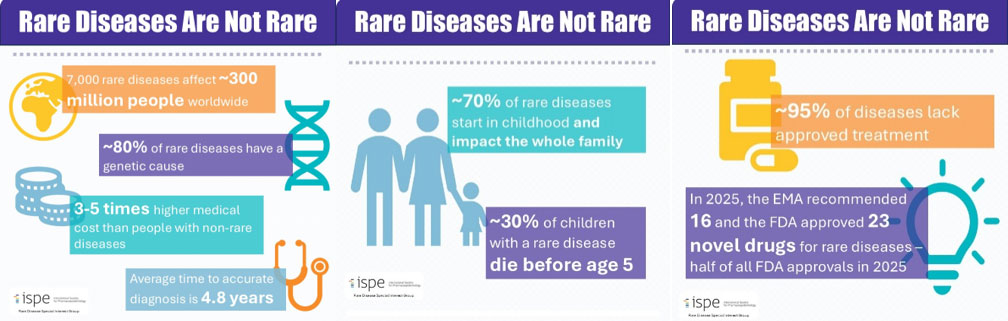
To coincide with Rare Disease Day, SIG members developed and shared a series of educational infographics for use on LinkedIn and other social media platforms. These materials highlighted key facts about rare diseases, the challenges faced by patients and families, and the importance of research and evidence generation in improving outcomes for people living with rare conditions.
The initiative provided an opportunity for members to engage broader audiences while increasing visibility for rare disease research and the contributions of the pharmacoepidemiology community. It also demonstrated how relatively simple, collaborative initiatives can amplify awareness and promote meaningful scientific communication.
Advancing Methodological Scholarship
Scientific collaboration remained a cornerstone of SIG activities throughout the year. One of our most significant accomplishments was the development of a manuscript focused on causal inference in rare disease research. The manuscript examines the application of target trial emulation and related methods to address the unique challenges of generating real-world evidence in small, heterogeneous populations. It also explores practical considerations, methodological limitations, and potential applications in regulatory and health technology assessment settings. The manuscript is currently undergoing the ISPE endorsement process with intention to submit to Pharmacoepidemiology & Drug Safety.
The manuscript reflects the collective expertise of contributors from industry and academia and highlights the value of the SIG as a forum for cross-sector collaboration, bringing together diverse perspectives to address emerging methodological questions in rare disease research.
In parallel, members identified additional opportunities for collaboration, including new initiatives focused on methodological limitations in rare disease research for decision-making, artificial intelligence and patient finding, and emerging approaches such as digital twins and synthetic controls for rare disease applications. These discussions have laid the groundwork for future SIG-led scholarship and educational programming.
Contributing to Regulatory Science
The Rare Disease SIG also expanded its engagement in regulatory science during 2026 through the development of public comments submitted on behalf of ISPE in response to the FDA draft guidance, Considerations for the Use of the Plausible Mechanism Framework to Develop Individualized Therapies Targeting Specific Genetic Conditions.
The comments highlighted the importance of methodological transparency, encouraged consideration of a broader range of comparator approaches beyond untreated natural history cohorts, and emphasized the value of pharmacoepidemiologic methods and real-world evidence across the development lifecycle. This effort illustrated how the collective expertise of SIG members can contribute constructively to ongoing policy discussions and help shape future approaches to evidence generation in rare and ultra-rare disease settings.
Supporting the ISPE Scientific Community
A major scientific contribution was the Rare Disease SIG-endorsed symposium on transportability methods at the 2026 ISPE Annual Meeting. Building on the Comparative Effectiveness Research SIG’s conceptual framework for transportability analysis in comparative effectiveness research, speakers examined how limited evidence can be extended to new populations in rare diseases, where small, geographically dispersed, and heterogeneous patient populations can also challenge the assumptions required for valid inference. The symposium connected practical methods and real-world applications with implications for regulatory and health technology assessment decisions.
The discussion emphasized that credible transportability depends on measuring important effect modifiers, identifying comparable patients, and aligning phenotypes and care settings. Speakers translated these requirements into two practical steps. First, researchers should develop transportable phenotypes using shared vocabularies, systematic code lists, clinical review, and cohort diagnostics, particularly when defining codes or identifying information are incomplete. Second, they should select and scrutinize methods that perform reliably in small samples, explore multiple approaches, and assess effect-modifier selection, population overlap, extreme weights, covariate balance, and effective sample size.
The central takeaway was that, before a transported estimate is used as regulatory or health technology assessment evidence, researchers must determine whether evidence from the source population can credibly apply to the target population. Although clear decision thresholds are still needed, the symposium offered a practical framework for evaluating feasibility, characterizing uncertainty, and making better use of limited rare disease evidence.
Members also participated in educational programming, poster sessions, and the Rare Disease Course at the Annual Meeting, creating opportunities for knowledge sharing and professional development while helping to strengthen connections across the broader ISPE community.
Looking Ahead
While we are proud of the accomplishments achieved in 2026, we are equally proud of the collaborative spirit that made them possible. The Rare Disease SIG continues to thrive because of the enthusiasm, expertise, and commitment of its members, who consistently contribute their time and knowledge to advance the field.
As we look toward 2027, we are excited to build upon this momentum through additional webinars and joint SIG initiatives, new manuscript collaborations, continued engagement in regulatory and policy discussions, and expanded exploration of emerging topics such as patient-centered evidence generation, artificial intelligence, causal inference, and innovative approaches to rare disease research. We thank all of our members for their contributions throughout the year and look forward to another year of collaboration, innovation, and impact in support of the rare disease community.
Authors: Julien Heidt Shippee, Laura Hester, Jocelyn Buisker
